Tag Archive for: Success

“Failure is better than regret.” When I first encountered this statement, it challenged everything I’d been taught about success. But the more I considered it, the more profound its truth became.

We typically view failure as something to avoid at all costs. Yet when placed alongside regret, failure transforms into something valuable—even necessary. This mirrors a principle I’ve long believed: it’s better to try and fail than to fail to try.

Every meaningful endeavor carries the possibility of failure. But here’s what matters: the process of engaging in that endeavor holds far more value than the outcome. Talk to successful entrepreneurs, artists, or athletes, and they’ll catalog their failures before their victories. The power didn’t come from avoiding mistakes—it came from embracing the process despite uncertainty.

Talk to anyone who has achieved any level of success, and they will tell you about the failures they had along the way. The power did not come from the outcome; the power came from engaging the process.

The principle is simple; the pain of regret for never attempting to pursue a dream is far greater than pursuing the dream and failing to achieve it. We are all born with a vast amount of potential. We all have goals and dreams for our lives. Any dream that continuously repeats in your mind is possible for achieving. You do not continuously think of something you are incapable of achieving. The question is not can you, it is will you.

Any goal worth having carries the risk of falling short, yet the true loss comes from ignoring the persistent visions and desires that keep resurfacing in your mind. A good life is not one without mistakes, but one with as few “what ifs” as possible—so if a dream keeps calling you, the real question isn’t whether you can achieve it, but whether you’re willing to try.

The author used Perplexity to assist with language editing and revision. The author takes full responsibility for the content of this article.

With the explosion of AI in virtually all aspects of our lives, including the workforce, how you decide to respond to it is up to you. You can choose to resist the tsunami of change or embrace it and begin preparing yourself for success in the face of change. In terms of the workforce, in addition to developing the technical skills you will need for success, having the proper mindset is also a critical factor in the process.

These suggestions are not new, they are reminders of what you instinctively already know. They serve as either kick starters to get you going, or confirmations to keep you going. Here are 4 key mindset adjustments you’ll need to continue or adapt to increase your chances of success in this new AI centered world both personally and professionally:

  1. Embrace Life-Long Learning

    Photo by Hurix Digital

In a world where not only technology, but knowledge in general, evolves rapidly, adopting a mindset of continuous learning is critical. This means making an active decision about acquiring new skills, staying updated with industry trends, and being open to new ideas. Life-long learning is not just about formal education but also about being curious and eager to grow.

Suggested Strategies:

  • Allocate time each week for learning something new, whether it’s a new software tool, a professional course, or something related to personal growth and development.
  • Attend webinars, workshops, and conferences to stay informed and network with like-minded professionals.
  • Get into the habit of reading—books, articles, research papers—related to your field, or some other topic of interest.
  1. Develop Resilience

If there is one thing that is for certain, it is setbacks and disappointments are going to occur in life. Developing the ability to bounce back from setbacks is a defining trait of successful individuals. Resilience includes maintaining a positive attitude in the face of setbacks, managing stress effectively, and viewing failures as opportunities for growth rather than unbeatable obstacles.

Suggested Strategies:

  • Create a regular practice, daily, if possible, of stress-reduction techniques such as meditation, exercise, yoga, or whatever works for you.
  • Look back on past setbacks and remember what you learned from them. Many of us can remember experiences that, while upsetting at the time they occurred, turned out to be one of the best things that happened to us.
  • Build a support network of colleagues, mentors and friends who can offer guidance and encouragement. There are few things in life as valuable as great relationships.
  1. Be Solution Oriented, Not Problem Centered

Are you a glass half empty of half full person? The cultivation of a solution-oriented mindset means approaching challenges with a positive attitude, focusing on finding solutions rather than dwelling on problems. This mindset is a choice and fosters innovation, creativity, and problem-solving, all of which are essential skills in a dynamic work or personal setting.

Suggested Strategies:

  • When faced with a challenge, consider a variety of potential solutions before deciding on the best course of action. The key is to focus on finding a solution rather than searching for who to blame, or wallowing in woe is me thinking.
  • Utilize your resources. You are not alone. Tap into your support network and create an environment where everyone is comfortable sharing ideas and offering possible solutions.
  • Celebrate your small wins and move forward towards solving bigger challenges to maintain motivation and momentum. This serves as a reminder that you have overcome obstacles in the past, and you will overcome them again.
  1. Prioritize Time and Energy Management for Productivity

One of my core values is the effective, efficient use of time. Effectively managing your time involves recognizing and honoring your values, setting clear goals, prioritizing tasks, and using your best tools and techniques to manage your workload efficiently.

Suggested Strategies:

  • Find a productivity tool you like such as a task manager app, calendar, or project management software tool to organize yourself and your work.
  • Break down larger projects into smaller, manageable tasks and set time goals for their accomplishment.
  • Practice working in time blocks using such tools as the Pomodoro Technique or some other time blocking system to maintain focus and prevent burnout. Balance is the key here.
  • It helps to recognize when your peak hours of energy are present. Are you a morning person, a night owl, or somewhere in between. Schedule your most important task for the time of day when you are at your peak energy level.

Personal and professional success requires more than just technical skills—it demands a fundamental shift in mindset. By embracing continuous learning, developing resilience, focusing on solutions, and prioritizing time management, you stand a much better chance of navigating the complexities of modern life and achieving long-term success. Remember, a positive/growth mindset is a powerful tool. Cultivate it effectively, and you’ll find yourself thriving amid the rapid changes in both your professional and personal life. [

Very few people would argue against the value of goal setting. It’s also no secret that many people fail to achieve goals they set for themselves. Failing to reach a goal can happen to anyone, and it is better to try and fail reaching a goal than failing to try at all. The real question becomes, is there a way to improve one’s chances of achieving the goals they set? The answer, yes!

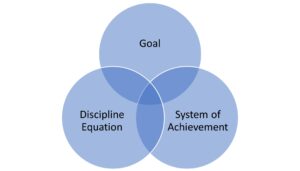
One of the key reasons people fail to achieve their goals is because they set goals without including two critical components: an understanding of the discipline equation and developing a measurable system of achievement. These three components all work together as a symbiotic system of goal realization. The system does not guarantee success, but it can certainly increase one’s chances of success.

Let’s take a quick look at this process.

The Goal

It all starts with the goal. Clearly defining what it is the one wants to achieve. When setting a goal, it is important that there is a real belief that reaching the goal is possible, and that it is internally motivated by the goal setter. It must be something you really want and believe you can do.

 The System of Achievement

The system of Achievement is where you determine what needs to be done to achieve the goal. It lays out the overall picture and decides what new habits need to be formed, and what daily actions need to be taken to achieve the goal.

Discipline Equation

Steven Bartlett author of Diary of a CEO provides one of the most concise explanations of the discipline equation process I’ve come across. Bartlett breaks the equation down into this simple formula:

Discipline = The Value of the Goal + The Reward of the Pursuit – The Cost of the Pursuit.

  1. What is the value, meaning, or benefit of achieving the goal you’ve set for yourself?
  2. No matter how challenging it may be, do you find the process of pursuing your goal enjoyable and psychologically rewarding? This element is directly connected to the system of achievement.
  3. Finally, one must also honestly assess if the cost of pursuing the goal is not enjoyable or psychologically rewarding. This determines if one will be able to persist through the challenges encountered in pursuit of the goal.


The discipline equation simply states: if the psychological and emotional cost of pursuing the goal is greater than the enjoyment experienced in the system of achievement, the discipline required to achieve the goal will not be strong enough to make it. The pursuit of the goal will inevitably be abandoned.


The opposite side of the equation of course is if the psychological and emotional value of the goal and system of achievement are greater than the pain experienced in pursuit of the goal, the discipline required to achieve the goal will be strong enough to increase the chances of success.


Growth, success, achievement, whatever term you use requires going through fear, anxiety, doubt, and uncertainty, and moving forward anyway. One of the key reasons people fail to achieve their goals is not taking how much of that they are willing to endure into consideration when setting out to pursue their goals.


Want to increase your chances of success in pursuing your goals? Have a clear picture of what it is. Keep that vision of achieving it in the forefront of your mind.

Develop a systematic process of the daily action steps you’re going to take to reach the goal, and if the psychological and emotional joy of the pursuit is greater than the pain experienced in the process your chances of success will increase exponentially.


It’s time to set a goal, develop the system of achievement, get going and enjoy the process. I believe in you, and if you believe in yourself, there is no stopping you.

Namaste.

The staff of the Greater Paterson OIC would like to congratulate Aura Lopez on her remarkable accomplishments in our Small Business and Office Management training program.

Aura came into our training program seeking to make a career change. She has a passion for business and wanted to strengthen her skills in order to pursue better opportunities. She was accepted into our Small Business and Office Management training program, which includes the opportunity to earn industry recognized certification in Entrepreneurship and Small Business (ESB) or Microsoft Office Specialist (MOS) in Excel.

Aura wasn’t satisfied with just one, she went on to earn both. Her commitment to achieving her goals and the work she put in to reach them was impressive to witness and speaks highly to the quality of her character.

We are confident that Aura will succeed in whatever endeavor she pursues next. We are grateful that we had the opportunity to work with her and we wish her all the best.

Article is posted by Hollis Nelson, written by Sergio Abrams

So, you say today is the day you’re going to do it. You’re finally going to start your own business and become the successful businessperson you want to be. But wait, didn’t you say that yesterday? In fact, you’ve been starting a business for years now, haven’t you? No, it isn’t the naysayers and no; it isn’t a lack of time. No, my friend, the problem is you and the wave you’ve yet to conquer is yourself. You’ve been fighting with yourself for years and it is your inner self which has clouded your mind with many fears and self-doubt. Your negative thoughts about what may happen cause you to become stuck in what’s called “analysis paralysis”.

That’s you analyzing and accepting every reason you believe you might fail, instead of analyzing all the reasons you may succeed. It is that self-doubt and inner voice feeding on your fears, telling you day in and day out that you will fail if you venture away from your safe place. Yes, that wave of fear that overcomes you each time the mere thought of venturing out on your own comes to mind, lies in wait, waiting to shoot you down and steer you back into your comfort zone. The voice says, “It’s too dangerous”, “no one’s going to buy that”, “you don’t want to leave your 9 to 5”, “starting your own business is way too hard”, “how are you going to pay your rent?”. Your fear and self-doubt win by knockout in the first round.

In the movie Castaway, actor Tom Hanks finds himself on a deserted island after a plane crash with seemingly no way of escape or being rescued. To survive he improvises and uses unconventional methods, including using a volleyball which he aptly names Wilson, as a companion whom he talks to, to stave off insanity. He soon realizes that no one’s coming to save him and if he’s going to get off that island, he’s going to have to save himself. Standing in his way is the great wave. The wave is a barrier between the island he’s stuck on and open waters and the chance to be saved. Eventually, he builds up the courage needed to face and overcome his great wave, and after he gets past his great wave, he looks back at the island that once held him captive.

Photo by: Jairo Diaz

The island that would have still held him captive had he not faced his greatest obstacle overcame the great wave.

You can survive with fear, but you cannot truly thrive with fear, because verily fear will only keep you stranded on your comfort zone island. Fear and self-doubt will tell you that trying is no longer an option, and only contentment with mediocrity and life regrets remains.

Each of us has a “great wave” we must overcome to find genuine success, but sadly, so few ever find the courage to do so, waiting for someone or something to come along and save us from our inner selves. Nope, no one’s coming to save you. No one can save you from yourself. This is a battle you will have to fight on your own and until you step on the battlefield and face the enemy within, there can be no victory. Verily, the road to success is the hardest road to take, which is why it is the road less traveled. However, for those who choose to face that wave, the reward of living is great.

Yes, there will always be naysayers and dream busters outside of you, waiting to tear you down with “you won’t succeed” bombs, and you may fail a few times along the way, but success is a journey, not an overnight mission. There is no instant recipe for success unless you plan on winning Lotto, and we all know the chances of that happening. If that’s your game plan, then hey, have at it, who am I to knock someone’s hustle?

In the end, there are only two choices, and as Yoda once said, “Try or do not try; there is no in between”.

You can choose to stay on your island of despair or overcome the “great wave” of fear and self-doubt and achieve your dreams.

It is all up to you!